Christina G. Lopez, MD, shares her preceptorship experience with Paul M. Friedman, MD
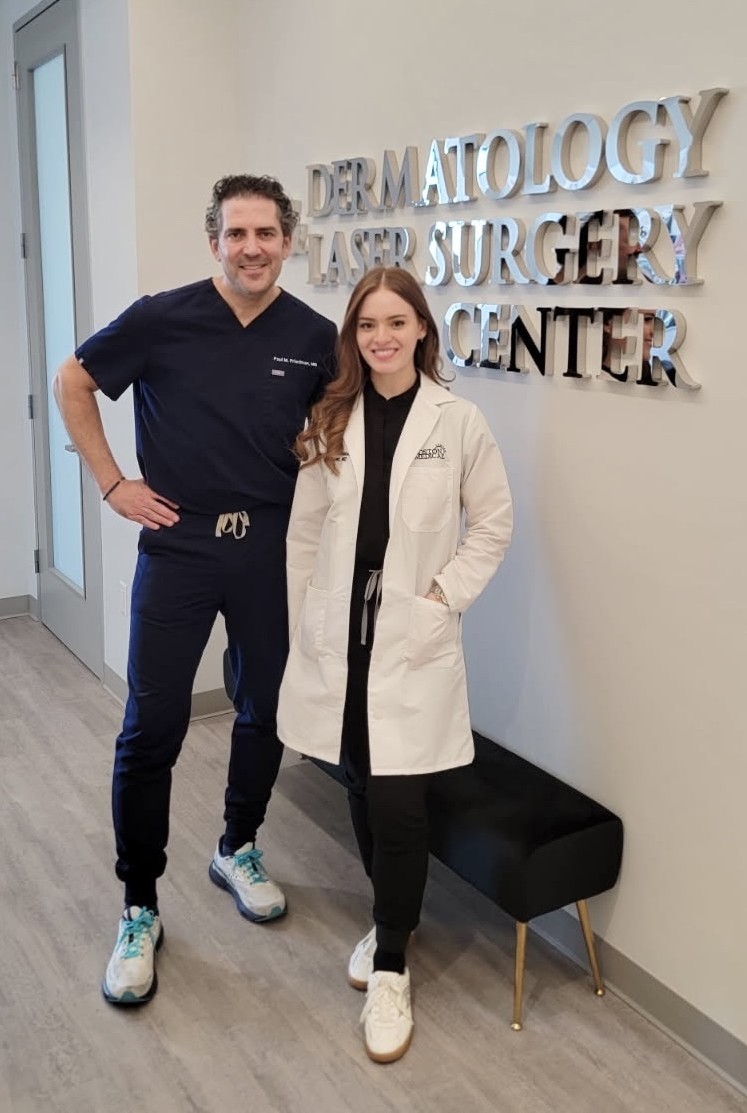
Spending a week at the Dermatology & Laser Surgery Center in Houston, Texas, under the mentorship of Dr. Paul Friedman through the ASLMS Preceptorship Program was a transformative experience that deepened both my technical skills and my sense of purpose in dermatology.
Innovation and Humanitarian Service
Returning to Houston, a city whose diversity first impressed me as a visiting medical student, I was reminded how cultural and ethnic variety shapes patient care. At Dr. Friedman’s practice, this inclusivity is woven into every aspect of laser medicine. The center exemplifies how cutting-edge technology and compassionate care can coexist, especially when serving patients across all skin types.
Dr. Friedman’s commitment to service extends beyond aesthetics. His pro bono initiatives, including picosecond-laser removal of branding tattoos for survivors of trafficking and pulsed-dye-laser treatment of vascular birthmarks in children, demonstrate how cosmetic dermatology can restore dignity and function. Many patients travel from across the country to seek his expertise, particularly for vascular birthmarks in newborns and for the management of laser-related complications. These efforts reflect a model of humanitarian innovation that I hope to emulate in my own career.
Clinical Learning and Patient-Centered Care
Throughout the week, I observed an extraordinary range of energy-based procedures encompassing vascular, pigmentary, resurfacing, and rejuvenation treatments. These included pulsed-dye laser for vascular birthmarks, rosacea, scars, and poikiloderma of Civatte; picosecond lasers for lentigines, pigmented birthmarks, and tattoo removal; fractional non-ablative lasers for rejuvenation, scars, and dyspigmentation; and fractional ablative 2910-nm resurfacing for scars, rhytides, xanthelasma, and skin laxity. I also witnessed expert use of neuromodulators, fillers, and biostimulators for rejuvenation, correction of facial asymmetry, masseter hypertrophy, and lipoatrophy.
Patient comfort was prioritized at every step. I learned how nitrous oxide and contact-cooling technology can reduce procedural discomfort, accelerate recovery, and even allow same-day combination of multiple devices and injectables. The emphasis on tailoring settings, performing test spots, and recognizing precise laser endpoints reinforced the centrality of safety, particularly in richly pigmented skin, which carries a higher risk of dyspigmentation and scarring without careful technique and parameter selection.
Mentorship, Scholarship, and Ethics
Equally memorable was the culture of mentorship. Each day concluded with thoughtful case discussions linking procedural choices to evidence from clinical studies, many of which were conducted within the practice. I had the opportunity to observe ongoing clinical trials evaluating fractional ablative 2910-nm resurfacing for rhytides and skin laxity across different skin types. I also gained insight into the study recruitment process, photodocumentation techniques, and the distinct goals of industry-initiated studies with investigator-tailoring compared to investigator-initiated protocols focused on patient experience and real-world outcomes.
These sessions also emphasized how to manage complications effectively, both those that may occur within the practice and the overwhelming majority referred from non-physician settings. Through these discussions, I learned how technical expertise, early recognition, and transparent communication are essential to achieving optimal outcomes and restoring patient trust.
These conversations also underscored the importance of approaching procedural dermatology as physicians first and proceduralists second. True expertise lies not only in technical execution but also in clinical judgment, recognizing when not to treat, distinguishing benign from malignant lesions, and identifying systemic or syndromic conditions that require referral or medical optimization before intervention. This ethical responsibility to prioritize patient safety embodies the principles of beneficence and nonmaleficence that define our profession.
Together, these experiences bridged science and real-world practice, illustrating how rigorous research, technical excellence, and mentorship converge to advance patient safety and innovation in laser and cosmetic dermatology.
Guiding Principles
This experience reinforced several guiding principles I will carry forward.
- Innovation and compassion must coexist. Integrating pro bono work into daily practice brings profound meaning to aesthetic medicine and reminds us that technology can be a tool for healing and restoring dignity.
- Diversity demands expertise. Providing safe, effective laser care for all skin types is not optional; it is an ethical and professional imperative.
- Comfort and precision are inseparable. Techniques such as contact cooling and nitrous oxide elevate both safety and patient trust, underscoring that technical excellence begins with patient-centered care.
- Lifelong learning sustains progress. Observing active clinical trials and post-laser recovery studies demonstrated how continual research drives improvement in safety, efficacy, and patient outcomes.
- Mastery includes managing complications. Thoughtful discussion of adverse events, both those encountered in the practice and those referred from non-physician settings, highlighted that expertise involves not only prevention but also the skill and empathy to restore patient confidence when complications arise.
- Dermatologic training underpins ethical practice. This experience reaffirmed that lasers and injectables are medical interventions requiring sound diagnostic judgment and adherence to the principles of beneficence and nonmaleficence.
Reflection and Gratitude
Beyond the procedural insights, this experience reminded me why I chose dermatology: the opportunity to blend science, artistry, and empathy in ways that tangibly improve lives. At the end of my rotation, Dr. Friedman gifted me a signed copy of his book with a thoughtful note, an emblem of mentorship that I will always treasure. I am deeply grateful to the ASLMS for investing in resident education through this extraordinary program and to Dr. Friedman and his entire team for their generosity, example, and commitment to advancing the field. My time in Houston reaffirmed that true excellence in laser and cosmetic dermatology lies not only in mastering technology but in using it to heal, empower, and inspire. I am excited for the future of laser and cosmetic dermatology as the field continues to expand its role in restoring function, enhancing confidence, and improving quality of life through innovation.